
How to Design a Small Garden to Feel Bigger
Make your small garden feel spacious with clever design tricks. Vertical planting, diagonal sight lines, mirrors, and scale-appropriate plants that transform tiny plots.
How to Design a Small Garden to Feel Bigger
A small garden is not a problem to be solved. It is a design opportunity that rewards precision, restraint, and a willingness to think in three dimensions. The gardens that feel most generous are rarely the largest -- they are the ones where every detail has been considered and every square metre earns its place.
The difference between a cramped courtyard and a garden that feels twice its actual size comes down to a handful of techniques. Diagonal sight lines, vertical planting, mirrors, scale-appropriate plants, and careful colour selection can transform a plot that measures just four by six metres into a space that feels open, layered, and full of life. None of these tricks require a large budget. Most require nothing more than a shift in how you think about the space.
This guide covers the core principles of small garden design and gives you practical strategies you can apply immediately, whether you are working with a tiny urban backyard, a paved terrace, or a compact front garden. It is part of our wider guide to garden design for any space, which covers fourteen different types of plot.
Break the Sight Line with Diagonal Paths
The single most effective technique for making a small garden feel larger is to run the main axis diagonally. A path that travels from one corner to the opposite corner is roughly forty percent longer than one running straight across the shorter dimension. That additional length gives the eye more distance to travel, and more distance means more perceived space.
A diagonal path also creates two triangular planting areas on either side, which naturally encourages asymmetry and layered borders. This is far more interesting than two narrow rectangular beds flanking a central path, which is the default layout most people fall into. The diagonal forces you to think about the garden from its corners rather than its edges, and that shift in perspective opens up design possibilities that a grid layout simply cannot offer.
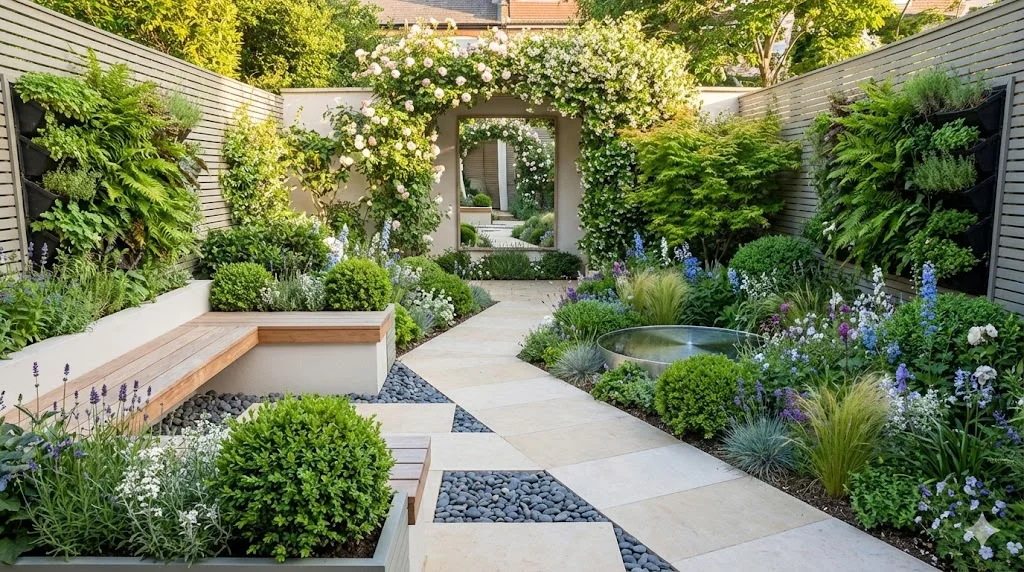
You do not need a winding gravel trail to achieve this effect. A line of stepping stones set at forty-five degrees through a low ground-cover planting works just as well. So does a strip of contrasting paving -- pale limestone against dark slate, for instance -- that draws the eye from the back door to a focal point in the far corner.
If your small garden is also enclosed by walls on all sides, many of these diagonal techniques overlap with the principles of courtyard garden design, where managing sight lines within a bounded space is equally critical.
Use Vertical Planting to Add a Third Dimension
In a small garden, the walls and fences are not boundaries -- they are planting surfaces. Every vertical surface you leave bare is wasted potential. A two-metre fence panel can support a climbing rose, a fan-trained fruit tree, or a living wall panel of ferns and sedums. That vertical planting adds volume, texture, and seasonal interest without consuming a single centimetre of ground space.
The most effective vertical planting strategies for small gardens include:
- Climbing plants on wires or trellis -- Trachelospermum jasminoides (star jasmine), Clematis armandii, and Hydrangea petiolaris are all excellent choices for covering walls without becoming unmanageable
- Espalier and fan-trained fruit trees -- apples, pears, and cherries trained flat against a sunny wall take up almost no depth while producing a genuine harvest
- Living wall panels or pocket planters -- modular systems that bolt to a fence or wall and hold small ferns, succulents, or herbs
- Tiered shelving or plant stands -- a set of narrow shelves against a shaded wall can hold a dozen pots in the space of a single container at ground level
- Hanging baskets and wall-mounted pots -- most effective near doorways and seating areas where they bring planting to eye level
The key principle is layering. Ground-level planting, mid-height shrubs, wall-trained climbers, and overhead elements like a small pergola with a scrambling vine create the impression of a mature, complex garden. The eye reads all those layers as depth, and depth is what makes a space feel larger than its footprint.
Mirrors and Reflective Surfaces
A well-placed mirror can double the perceived depth of a small garden in an instant. The technique is centuries old -- the great walled gardens of the seventeenth century used mirrored panels to extend vistas -- and it works just as well in a modern urban plot.
The most convincing mirror placements share a few rules. First, position the mirror at the end of a sight line, ideally framed by planting on both sides so the reflected image appears to be a continuation of the garden rather than an obvious trick. Second, angle the mirror very slightly off-perpendicular so it does not reflect the viewer directly back at themselves. Third, use an outdoor-grade acrylic mirror rather than glass -- it is lighter, safer, and resists weather better.
Arch-shaped mirrors framed by climbers are particularly effective because they mimic the appearance of a doorway or window into another garden room. The illusion is strongest when the planting in front of the mirror matches the reflected planting behind the viewer.
Beyond mirrors, other reflective surfaces contribute to the sense of space. A small water feature with a still, dark surface reflects the sky and surrounding planting. Polished stone or pale-coloured paving bounces light into shaded corners. Even a glazed pot in a deep blue or black finish adds small points of reflection that make the garden feel brighter and more open.
Choose Plants at the Right Scale
Nothing destroys the sense of space in a small garden faster than plants that are too large for the setting. A Prunus avium (wild cherry) that reaches fifteen metres at maturity will overwhelm a four-metre garden within a decade. Yet a bare plot feels exposed and uninviting, so you need trees and shrubs -- just the right ones.
Miniature and dwarf trees are the foundation of small garden planting. Acer palmatum (Japanese maple) in its smaller cultivars, Amelanchier lamarckii (snowy mespilus), Malus 'Red Sentinel' (crab apple), and Cornus kousa all stay within manageable proportions while providing canopy, seasonal colour, and structure. Multi-stemmed forms are especially valuable because they create a light, open canopy that lets sunlight through to the planting below.
Shrubs should be naturally compact or respond well to regular pruning. Sarcococca confusa (sweet box), Pittosporum tobira 'Nanum', and Hebe cultivars all earn their place in tight spaces. Avoid anything that needs constant hacking back to stay in bounds -- the plant will look stressed and the garden will look like a battle.
Perennials and grasses provide the bulk of seasonal interest. In small gardens, choose species with a long flowering season or attractive foliage that lasts well into autumn. Hakonechloa macra (Japanese forest grass), Epimedium, and Geranium 'Rozanne' are all workhorses that perform reliably without spreading aggressively.
The overall principle is simple: every plant must justify its space across at least two seasons. If it flowers for two weeks in June and does nothing for the remaining fifty weeks, it does not belong in a small garden.
Create the Illusion of Depth with Colour
Colour is one of the most underused tools in small garden design. The principle is borrowed from landscape painting: cool, pale colours recede while warm, dark colours advance. By placing hot reds and deep purples near the house and pale blues, silvers, and whites at the far end of the garden, you create an artificial sense of depth that makes the space appear longer than it is.
At the back of the garden, plant Verbena bonariensis, pale lavender, white Gaura lindheimeri, and silver-leaved Artemisia. These plants dissolve into the background, especially in soft light, and the eye reads them as being further away than they are.
Near the house or seating area, bolder colours like deep red dahlias, orange Crocosmia, and rich purple salvias anchor the foreground and draw attention to the immediate surroundings. The contrast between the strong foreground and the fading background amplifies the sense of distance.
This colour gradient also applies to hard landscaping. Darker paving near the house transitioning to lighter materials at the far boundary extends the visual depth. Even painting the back wall or fence in a soft, receding colour -- pale grey, sage green, or off-white -- pushes it visually further away.
Focal Points That Draw the Eye Forward
A small garden needs at least one strong focal point positioned to pull the eye through the space. Without one, the gaze bounces off the boundaries and the garden feels its true size. With one, the eye is drawn along a path or sight line, and the journey itself creates the impression of distance.
Effective focal points for small gardens include a specimen tree underplanted with ground cover, a sculptural pot or water feature, a bench positioned at the end of a diagonal path, or an ornamental arch framing a view -- even if the "view" is simply a mirror or a painted panel.
The placement matters as much as the object. Position the focal point at the far end of the longest sight line, which in most small gardens means the far corner diagonally opposite the main viewpoint. Framing it with planting on both sides narrows the view and creates a sense of perspective, much like an avenue of trees in a large garden but at a compact scale.
Avoid multiple competing focal points. In a small space, two strong features fight for attention and make the garden feel cluttered. Choose one primary focal point and let everything else support it.
Multi-Functional Furniture and Containers
In a small garden, everything should serve more than one purpose. A bench with built-in storage underneath holds cushions, tools, and pots. A raised bed doubles as informal seating along its edges. A table that folds flat against the wall disappears when you need the full garden for a gathering.
Container gardening is essential in small spaces, not as a compromise but as a deliberate strategy. Containers allow you to move plants around seasonally, bringing the best performers to the front and retiring spent plants to a less visible spot. They also let you grow plants that would not survive in your garden soil -- acid-loving camellias in a limestone area, for instance, or tender herbs that overwinter indoors.
Group containers in odd numbers and vary the heights. Three pots of different sizes clustered together look intentional; four identical pots in a row look institutional. Raise some on pot feet or upturned bricks to create levels within the group.
If you are working with a very small space that has no ground soil at all, containers become the entire garden. The principles of balcony garden design apply directly, including weight considerations, wind exposure, and the importance of lightweight, well-drained compost.
When you are planning your layout digitally, you can experiment with container placement and furniture positions before buying anything, which is especially valuable in small spaces where a single wrong purchase can dominate the entire garden.
Simplify Your Materials
A common mistake in small garden design is using too many different materials. Three types of paving, two styles of edging, timber decking meeting brick meeting gravel -- the visual noise makes the garden feel busy and cramped. In a large garden, material changes can define zones. In a small garden, they fragment the space.
Choose one primary paving material and, at most, one accent. Large-format pavers in a pale, neutral tone make a small garden feel more open because there are fewer joints and the eye reads the surface as a single plane rather than a patchwork. Laying pavers in a stretcher bond pattern running away from the main viewpoint elongates the perspective.
If you want to introduce a second material, use it purposefully: a band of dark pebbles inset across a pale stone terrace creates a horizontal line that widens the space visually. Timber decking can work well as a distinct seating platform, but keep the colour close to the surrounding paving so it reads as part of the same space rather than an interruption.
The same restraint applies to fencing, walling, and edging. One material, consistently applied, creates a calm backdrop that lets the planting take centre stage.
Start Designing Your Small Garden
The most important step is the first one: measure your space accurately and start sketching. Many of the techniques in this guide -- diagonal paths, focal point placement, colour gradients -- only work when they are tailored to the specific dimensions and orientation of your plot. A technique that transforms one garden can feel forced in another.
Begin with these steps:
- Measure your plot precisely, including the position of doors, windows, downpipes, and any level changes
- Note the light -- where does full sun fall at midday, and where is permanent shade cast by buildings or trees?
- Identify your longest diagonal -- this is the most important dimension in your garden
- Choose one focal point and position it at the end of that diagonal
- Select three or four plants that suit your light conditions and repeat them through the borders
- Keep materials simple -- one paving type, one fence colour, one pot style
A small garden designed with care will give you more pleasure per square metre than any sprawling plot left to chance. The constraints are real, but they are also the engine of good design. Work with them, not against them, and you will create a garden that feels generous, layered, and entirely your own.
For more guidance on designing for specific space types, return to our complete guide to garden design for any space.
Garden Design Team
Expert garden designers sharing tips, inspiration, and practical advice for creating beautiful outdoor spaces.
Explore professional garden design
Gardenly3D is a paid professional garden-design application. See plans for included capabilities and availability.
Join the waitlistRelated articles
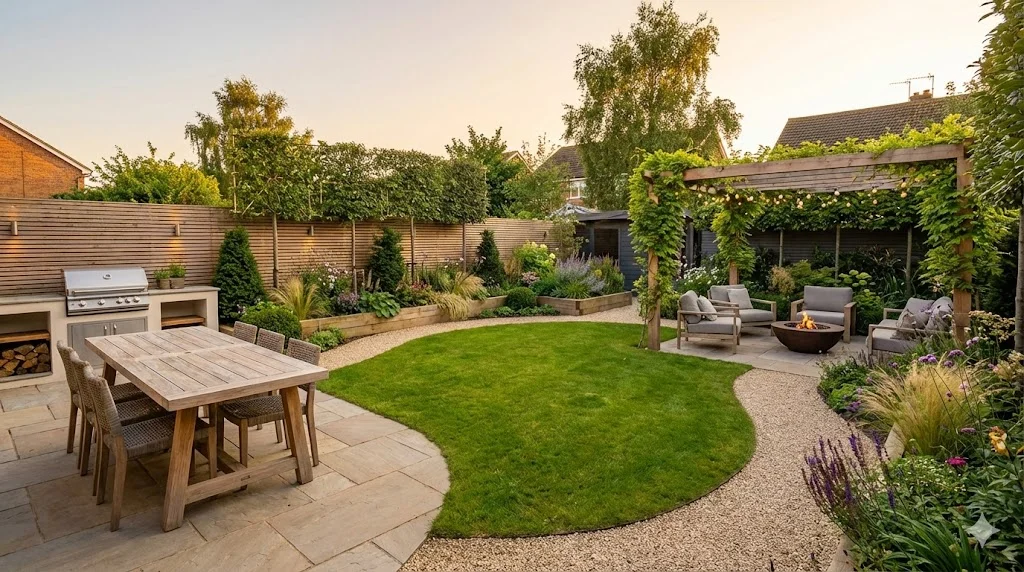
Backyard Garden Design: Creating Your Outdoor Sanctuary
Design a backyard that works as an outdoor living space. Zoning for dining, relaxation, and play, with privacy screening and year-round planting.
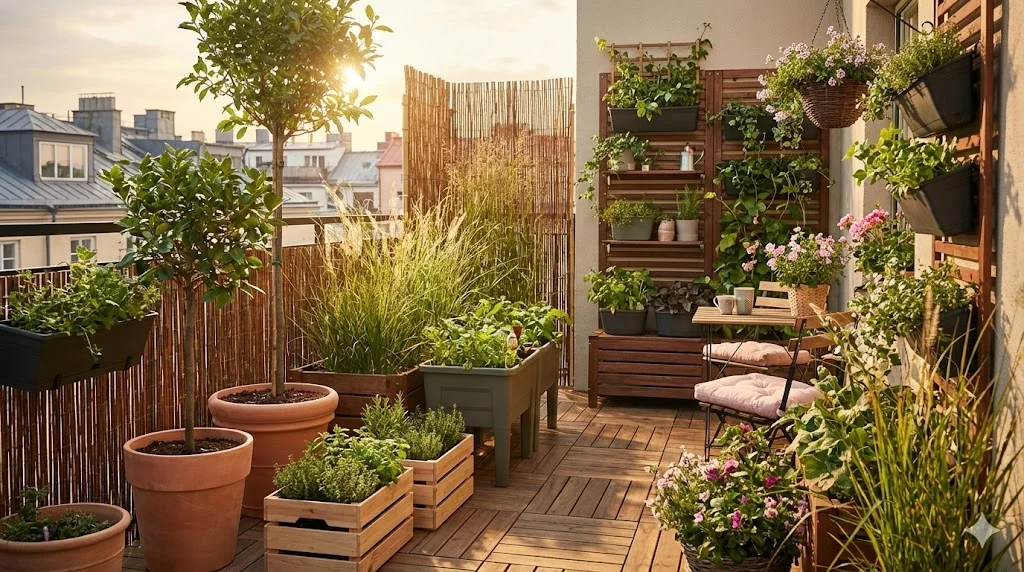
Balcony Garden Design: Growing in Containers
Create a thriving balcony garden with smart container choices, wind-resistant plants, vertical systems, and self-watering solutions for high-rise growing.
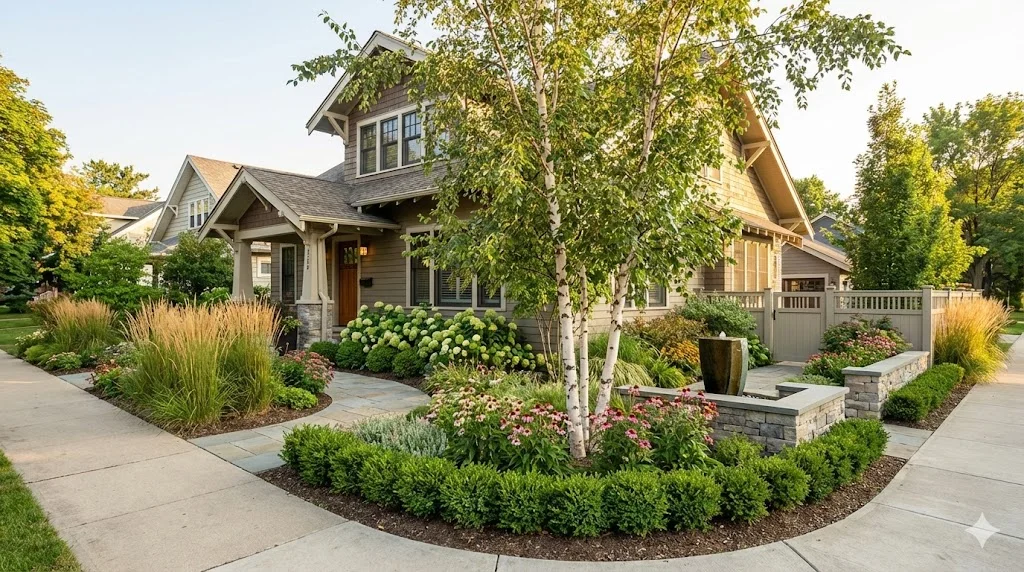
Corner Lot Garden Design: Two-Sided Curb Appeal
Design a corner lot garden that impresses from both streets. Dual frontage planting, visibility sightlines, wraparound beds, and privacy from two directions.