
Front Yard Garden Design: Curb Appeal and Function
Design a front garden that welcomes visitors and lifts your home's kerb appeal. Path design, entrance planting, year-round interest, and practical solutions.
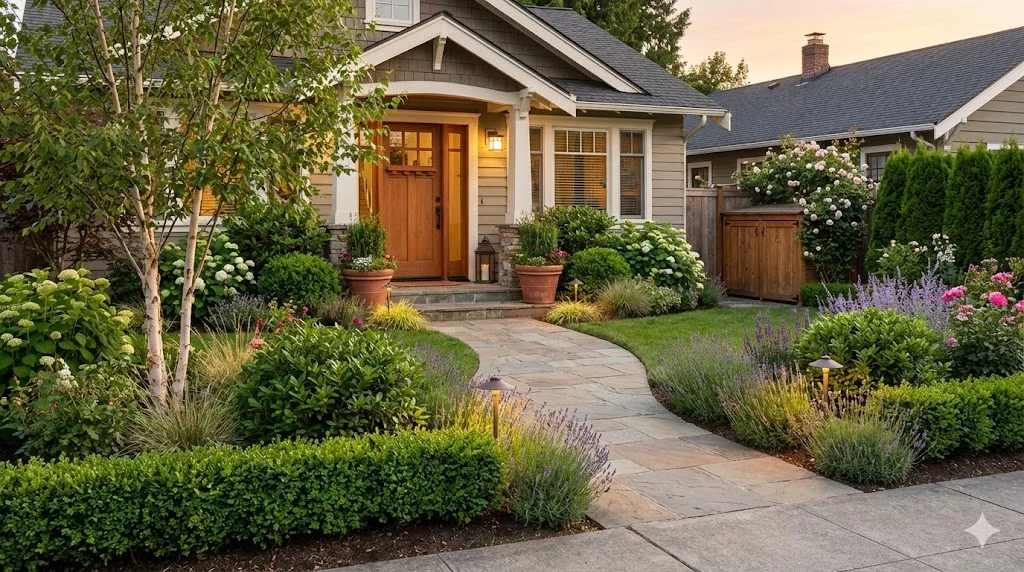
The front garden is where your home meets the world. It is the view from the street, the first thing a guest notices, and the space you walk through every single day. Yet for many garden owners, front yard landscaping remains an afterthought -- a rectangle of lawn flanked by a pair of neglected shrubs, a concrete path running from gate to door, and little else. This is a missed opportunity. A well-considered front garden design can transform the entire feel of a property, lifting its kerb appeal while solving practical problems like parking, bin storage, and security.
Unlike a back garden, the front is public. Neighbours see it, delivery drivers walk through it, and passers-by form an impression of your home from it. That public nature creates a different set of challenges. You need a design that looks generous and welcoming without sacrificing privacy, that accommodates cars and wheelie bins without looking like a service yard, and that stays attractive through every season -- not just the height of summer.
Path Design: The Spine of the Front Garden
The path from the pavement to your front door is the single most important element in front garden design. It shapes how people move through the space and how the garden is experienced. A well-designed path does more than connect two points; it sets the pace, guides the eye, and establishes the character of the whole garden.
Straight paths suit formal settings and narrow plots where a direct route is the only sensible option. But even a straight path can be softened with generous planting along both edges, so the journey feels enveloped rather than exposed. For wider plots, a gently curving path adds a sense of discovery, drawing visitors through the garden rather than past it.
Materials matter enormously. Natural stone flags, reclaimed brick in herringbone patterns, and bound gravel all feel grounded and attractive. Avoid plain grey concrete slabs, which tend to look municipal. If budget is tight, a simple gravel path edged with timber boards or metal strips can look remarkably elegant.
Consider width carefully. A path less than 90 centimetres (3 feet) wide feels pinched, particularly when planting spills over the edges. Aim for at least 1.2 metres (4 feet) if space allows, so two people can walk side by side comfortably.
Entrance Planting: Setting the Tone
The area immediately around the front door is where planting makes the greatest impression. This is the focal point visitors see as they approach, and it is worth investing in generously.
A pair of matched plants flanking the doorway creates instant formality and structure. Standard bay trees (Laurus nobilis), box balls (Buxus sempervirens), or clipped Portuguese laurel (Prunus lusitanica) in good-quality pots are classic choices that work with almost any house style. Keep them well-watered and fed, and they will look smart year-round.
Climbing plants trained around the doorframe add a layer of romance. A repeat-flowering climbing rose such as Rosa 'Generous Gardener' or Rosa 'New Dawn' will produce scented blooms from early summer well into autumn. For shadier entrances, star jasmine (Trachelospermum jasminoides) or a shade-tolerant clematis like Clematis montana will clothe the wall with foliage and flower.
Seasonal pots on the doorstep give you the freedom to change the display throughout the year. Spring bulbs -- tulips, narcissi, muscari -- give way to summer pelargoniums and trailing lobelia, then to autumn heathers and ornamental kale, and finally to winter cyclamen and evergreen boughs. Grouping pots in odd numbers (three or five) creates a natural, layered look.
If you want to experiment with different entrance planting arrangements before committing, testing your ideas in a visual planner can help you see how proportions and colours work together.
Low Hedges and Boundary Planting
The boundary between a front garden and the street deserves careful thought. Too high and the garden feels walled off; too low and there is no sense of enclosure at all. The sweet spot for most front gardens is a hedge or boundary planting between 60 centimetres and 1 metre (2 to 3.5 feet) high -- enough to define the space without blocking sightlines or making the house feel hidden.
Box (Buxus), lavender (Lavandula), and dwarf privet (Ligustrum) are reliable choices for formal low hedging. For a more relaxed feel, a mixed hedge of potentilla, hebe, and shrub roses provides colour and texture while still reading as a clear boundary. Native options like hawthorn (Crataegus monogyna) kept low and tight offer wildlife value alongside structure.
Where a hedge is not practical -- along a shared driveway, for example -- low walls topped with planting, metal railings with climbers, or even a simple change in surface material can define the edge. The goal is always to signal "this space is cared for" without creating a fortress.
For more on how front garden boundaries work on plots with two street frontages, see our guide to corner lot garden design.
Year-Round Interest: The Four-Season Front Garden
A front garden that looks spectacular in June but dreary from November to March is only doing half its job. Because the front is visible every day, year-round interest is not a luxury -- it is essential.
The backbone of a four-season front garden is evergreen structure. Clipped hedging, a sculptural evergreen such as Pittosporum tenuifolium 'Tom Thumb', or a dwarf conifer provides form when herbaceous plants have died back. Evergreen ground cover like Vinca minor, Pachysandra terminalis, or low-growing heathers fills gaps and suppresses weeds.
Layer seasonal highlights over this framework:
- Spring: Bulbs naturalised in borders -- crocuses, daffodils, tulips -- followed by forget-me-nots and wallflowers.
- Summer: Roses, lavender, hardy geraniums, salvias, and penstemons for colour from June to September.
- Autumn: Grasses like Miscanthus sinensis and Stipa tenuissima catch the low light beautifully. Japanese maples and amelanchiers provide foliage colour.
- Winter: Evergreen structure comes into its own. Add winter-flowering shrubs -- Viburnum x bodnantense 'Dawn', Sarcococca confusa (Christmas box), or Hamamelis (witch hazel) -- for scent and flower in the coldest months. Berrying shrubs like cotoneaster and pyracantha bring colour and feed birds.
Aim for at least two points of interest in every season. If you find a gap in the calendar, fill it with a well-chosen container display.
Neighbour-Friendly Design
Front garden design inevitably involves considering those who live around you. A front garden that is thoughtfully designed with neighbours in mind builds goodwill and avoids friction.
Keep boundary planting to a reasonable height so it does not cast shade over a neighbour's plot or block natural light to their windows. Avoid planting vigorous species like bamboo or Russian vine near shared boundaries, as they can spread and cause disputes. If you share a driveway, agree on maintenance responsibilities early and choose planting that will not drop berries or leaves onto their car.
Sound can matter too. A gravel drive that crunches underfoot at midnight may not endear you to a neighbour whose bedroom faces the street. Consider bound gravel or resin-bound surfaces, which are quieter and still permeable.
The best front gardens look as though they belong to the whole street, lifting the character of the neighbourhood while clearly expressing the personality of their owner. This is a balance, not a contradiction.
Practical Solutions: Bins, Parking, and Security
No amount of beautiful planting will matter if the front garden looks cluttered by wheelie bins or dominated by a car. Good front garden design solves these practical problems elegantly.
Bin Storage
Bins are one of the biggest visual challenges in front yard landscaping. Purpose-built bin stores -- timber screens, slatted enclosures, or brick-built bays -- hide them completely while keeping them accessible for collection day. Position the store close to the street edge so you do not have to wheel bins through the garden. Planting a climber over the top of a timber bin store softens it further.
Parking Integration
Where a front garden must accommodate a car, the key is to avoid paving the entire space. Permeable paving or gravel for the parking area, combined with generous planting in borders on either side, keeps the garden feeling green. Rumble strips or a simple change in surface material can separate the parking zone from the planted area. Consider using planted channels or gravel strips between paving slabs to break up hard surfaces and improve drainage.
Remember that in many areas, planning regulations require front garden paving to be permeable to reduce surface water run-off. Check your local rules before laying any hard surface.
Security Lighting
Well-placed lighting improves both safety and atmosphere. Low-level path lights guide visitors to the door without flooding the garden with harsh light. A downlight above the door illuminates the entrance and deters unwanted visitors. Solar-powered stake lights are the simplest option; for a more permanent solution, mains-powered LED bollards or recessed path lights give a cleaner look.
Avoid bright, motion-activated floodlights pointing toward the street -- they annoy neighbours and create harsh shadows that actually make it harder to see. Softer, always-on lighting at a low level is more effective and more pleasant.
For broader advice on designing outdoor spaces that balance beauty and function, our guide to garden design for any space covers principles that apply to front and back gardens alike.
Small Front Gardens: Making the Most of Limited Space
Many front gardens are modest -- sometimes no more than a few square metres between the house wall and the pavement. In a small space, every decision carries more weight, and simplicity is your greatest ally.
Choose a single strong theme rather than trying to cram in too many ideas. A pair of matching pots, a single climber on the wall, and a well-maintained low hedge can be more effective than a complicated planting scheme that ends up looking busy.
Vertical planting is invaluable. Wall-mounted planters, trellises with climbers, and hanging baskets draw the eye upward and add greenery without eating into floor space. A single well-chosen tree -- a multi-stem birch (Betula utilis var. jacquemontii), a crab apple (Malus 'Evereste'), or a compact magnolia -- can anchor a small front garden and provide seasonal drama without overwhelming it.
If you are drawn to a more informal, planted-up approach for your front garden, our guide to cottage-style front garden design explores how to create that layered, welcoming feel even in a compact space.
Putting It All Together: Your Front Garden Action Plan
Designing a front garden that balances kerb appeal with everyday function does not require a large budget or a grand plot. It requires clear thinking about priorities and a willingness to address the practical alongside the beautiful. Here is a simple action plan to get started:
- Assess what you have. Measure the space, note the aspect (which direction it faces), check soil type, and identify existing features worth keeping.
- List your practical needs. Bin storage, parking, bicycle storage, a path wide enough for pushchairs -- write them all down before you think about plants.
- Define the path. Decide on the route from gate to door, the material, and the width. Everything else flows from this.
- Choose your boundary. Low hedge, fence, railing, or open -- decide how you want to define the edge and select materials and plants accordingly.
- Build the evergreen framework. Plant the structural elements first: hedging, evergreen shrubs, any trees. These give the garden its bones.
- Layer in seasonal colour. Add perennials, bulbs, and seasonal pots to create interest through every month.
- Solve the ugly bits. Design bin storage, screen utility meters, and plan lighting before the garden is planted, not after.
- Maintain consistently. A front garden is always on show. Fifteen minutes a week -- deadheading, sweeping the path, tidying edges -- keeps it looking sharp.
A garden design tool can help you map out proportions, test plant placement, and share ideas with family or a landscaper before any digging begins.
The front garden sits at the intersection of private taste and public presence. Get it right, and you create a space that welcomes visitors, lifts your mood every time you come home, and adds genuine value to your property. Whether you are working with a generous suburban plot or a narrow terrace strip, the principles remain the same: a clear path, generous planting, year-round interest, and practical solutions handled with care. Your front garden is the handshake your home offers the world -- make it a good one.
For ideas on designing the private side of your property with the same attention to detail, see our guide to backyard garden design.
Garden Design Team
Expert garden designers sharing tips, inspiration, and practical advice for creating beautiful outdoor spaces.
Explore professional garden design
Gardenly3D is a paid professional garden-design application. See plans for included capabilities and availability.
Join the waitlistRelated articles
Backyard Garden Design: Creating Your Outdoor Sanctuary
Design a backyard that works as an outdoor living space. Zoning for dining, relaxation, and play, with privacy screening and year-round planting.
Balcony Garden Design: Growing in Containers
Create a thriving balcony garden with smart container choices, wind-resistant plants, vertical systems, and self-watering solutions for high-rise growing.
Corner Lot Garden Design: Two-Sided Curb Appeal
Design a corner lot garden that impresses from both streets. Dual frontage planting, visibility sightlines, wraparound beds, and privacy from two directions.