
Garden Design for the Pacific Northwest
Design a lush Pacific Northwest garden with native PNW plants, moss gardens, rain management strategies, and plants for wet winters and dry summers.
Garden Design for the Pacific Northwest
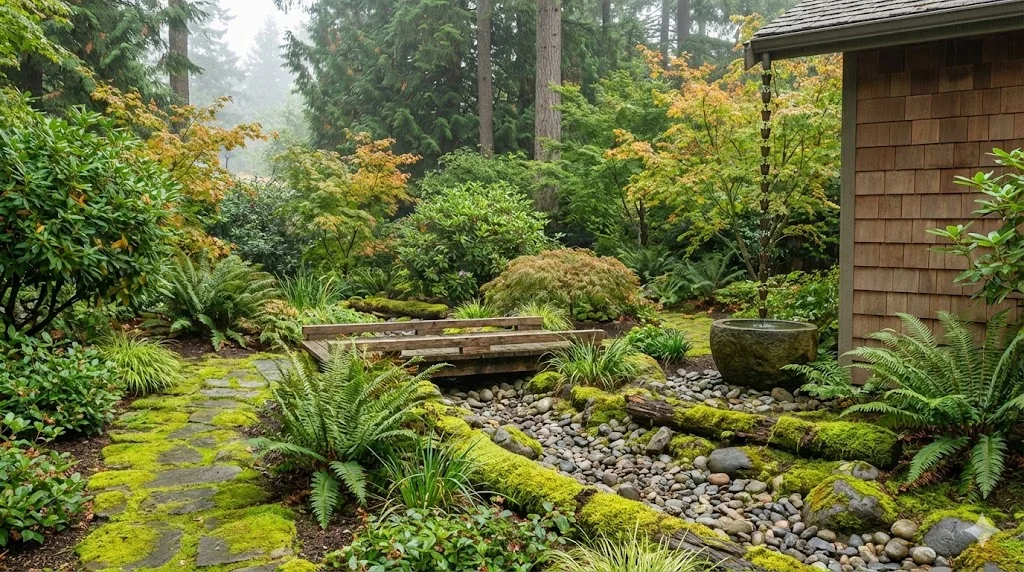
The Pacific Northwest — stretching from northern California through Oregon and Washington into British Columbia — possesses one of the most distinctive garden climates in the world. The legendary wet winters and surprisingly dry summers create a dual-season challenge that rewards designers who understand both extremes. When you get it right, the result is a garden of extraordinary lushness: emerald moss carpeting stone, towering conifers filtering light into golden shafts, native ferns unfurling in rich woodland understories, and borders packed with plants that thrive in the mild, maritime conditions.
This guide is part of our Garden Design for Your Climate Zone series. It covers the unique opportunities and challenges of gardening in the PNW, from Portland to Seattle to Vancouver and the islands, valleys, and mountains between.
Understanding the PNW Climate
The Pacific Northwest climate west of the Cascades is classified as oceanic or Mediterranean with a maritime influence, depending on your exact latitude. Its key characteristics include:
- Wet winters: October through April brings 70–80% of annual rainfall. Portland receives about 920 mm (36 inches) annually; Seattle about 940 mm (37 inches); Vancouver about 1,150 mm (45 inches).
- Dry summers: July and August are remarkably dry — Seattle averages only 18 mm (0.7 inches) of rain in July, comparable to many Mediterranean cities.
- Mild temperatures: Winter lows rarely drop below -5 C (23 F) in lowland areas. Summer highs average 24–27 C (75–80 F), though heat waves above 35 C (95 F) are becoming more frequent.
- USDA Zones 7b–9a: Most lowland PNW gardens fall in Zones 8a–8b. Higher elevations and inland valleys may be Zone 7 or even 6.
- Acidic soil: Abundant rainfall leaches calcium, producing naturally acidic soils ideal for rhododendrons, blueberries, and conifers.
- Extended cloud cover: Overcast skies persist for weeks during winter, but the long summer days (16+ hours at midsummer) deliver intense growing conditions.
The PNW gardener's superpower is the ability to grow plants from vastly different origins — Japanese maples beside English roses beside Chilean bamboo beside native sword ferns. The mild, moist climate is an international meeting ground for the world's temperate plants.
Designing for the Dual Season
The PNW's split personality — nine months of cloud and rain followed by three months of surprising drought — demands a garden design that manages both extremes.
Managing Winter Wet
Winter is when PNW gardens face their greatest test. Months of persistent rain saturate soil, promote root rot in susceptible plants, and create conditions that favor slugs, snails, and fungal diseases.
Design strategies for wet winters:
- Raised beds and berms — Elevating planting areas even 15–20 cm improves drainage dramatically and keeps root crowns above waterlogged soil
- Gravel mulch around crowns — Mediterranean plants (lavender, rosemary, cistus) survive PNW winters if their crowns are kept dry with a collar of gravel
- Rain gardens — Depressed areas planted with moisture-tolerant natives that capture and slowly absorb winter runoff
- French drains and swales — Underground drainage channels move excess water away from borders and patios
- Permeable paving — Gravel, permeable pavers, and stepping stones set in ground cover allow rain to infiltrate rather than pool
Managing Summer Drought
The PNW's dry summers catch many new gardeners off guard. After months of rain, the tap shuts off abruptly in late June, and by August, unwatered gardens can look parched.
Strategies for dry summers:
- Choose drought-tolerant species — Many plants from similar Mediterranean-type climates thrive in PNW summers without supplemental water once established. The mild, wet PNW climate also shares remarkable similarities with the UK and northern Europe, which is why so many British garden plants perform beautifully here.
- Deep mulch — 7–10 cm (3–4 inches) of arborist wood chips or bark mulch retains moisture and keeps roots cool
- Water wisely — Deep, infrequent soaking encourages deep root systems. Drip irrigation beats overhead sprinklers
- Establish in fall — Plant in September and October so roots establish during the wet season, reducing summer water needs
- Accept summer dormancy — Some native plants, like Oregon grape, naturally slow or go semi-dormant in summer. This is healthy, not a problem.
The PNW Native Plant Garden
The Pacific Northwest is home to some of North America's most beautiful native plants. A garden rooted in the native flora connects you to the regional landscape and supports local wildlife:
Native Trees
- Western red cedar (Thuja plicata) — The signature tree of the PNW, fragrant, majestic
- Douglas fir (Pseudotsuga menziesii) — Towering forest giant, best for larger properties
- Vine maple (Acer circinatum) — Multi-stemmed, brilliant fall color, perfect understory tree
- Pacific madrone (Arbutus menziesii) — Peeling cinnamon bark, evergreen, drought-tolerant
- Oregon white oak (Quercus garryana) — Structural, wildlife-supporting, drought-tolerant once established
Native Shrubs
- Salal (Gaultheria shallon) — Evergreen, shade-tolerant, edible berries
- Oregon grape (Mahonia aquifolium) — The state flower of Oregon, yellow spring flowers, blue berries
- Red flowering currant (Ribes sanguineum) — Drooping clusters of pink flowers, early spring
- Oceanspray (Holodiscus discolor) — Cascading white flower clusters, June bloom
- Nootka rose (Rosa nutkana) — Fragrant native rose, pink flowers, red hips
Native Perennials and Ground Covers
- Sword fern (Polystichum munitum) — The quintessential PNW fern, evergreen, tough
- Inside-out flower (Vancouveria hexandra) — Delicate woodland ground cover
- Western bleeding heart (Dicentra formosa) — Pink or white hearts, long bloom season
- Camas (Camassia quamash) — Blue spring bulb, historic food plant, stunning en masse
- Kinnikinnick (Arctostaphylos uva-ursi) — Evergreen ground cover, red berries
Moss Gardens: The PNW Specialty
Few places on earth are better suited to moss gardening than the Pacific Northwest. The combination of reliable moisture, mild temperatures, filtered light, and acidic soil creates conditions where moss thrives naturally. Rather than fighting moss, skilled PNW designers embrace it:
- Moss as lawn replacement — In shaded areas, moss forms a velvety, maintenance-free carpet that never needs mowing, feeding, or watering
- Moss on stone — Encourage moss colonization on walls, boulders, and pathways for an aged, settled look
- Moss gardens — Dedicated moss gardens in the Japanese style, with shaped moss mounds, stone arrangements, and gravel raked areas
- Moss between pavers — Stepping stones with moss-filled joints create a naturalistic, woodland path effect
To encourage moss: maintain shade, keep surfaces moist, ensure good drainage (moss does not like standing water), and avoid foot traffic during dry periods.
The Woodland Garden
The PNW's native forest ecosystem — towering conifers, layered understory, rich humus soil — provides the template for one of the region's most beautiful garden styles: the woodland garden.
Key elements of PNW woodland garden design:
- Canopy layer — Conifers or large deciduous trees (maple, oak) provide the overhead framework and filtered light
- Understory layer — Smaller trees and large shrubs: vine maple, Japanese maple, stewartia, rhododendron
- Shrub layer — Medium shrubs: huckleberry, Oregon grape, fothergilla, pieris
- Herbaceous layer — Ferns, hostas, epimedium, hellebores, trillium, bleeding heart
- Ground layer — Moss, kinnikinnick, wild ginger, bunchberry
The layered structure of a woodland garden maximizes biodiversity, manages rainfall naturally (each layer intercepts and slows water), and creates a sense of immersive, cathedral-like beauty.
When you design the layers of your woodland garden in three dimensions, you can see how canopy, understory, and ground layers interact with light and space before planting.
A well-designed PNW woodland garden feels inevitable — as if nature made it. The art lies in editing and arranging, not in imposing.
The Mixed Border in PNW Conditions
The mild PNW climate supports a remarkably diverse mixed border. Plants from the UK, Japan, South Africa, Chile, and the Mediterranean all coexist happily in PNW conditions:
- Roses — David Austin and hybrid teas thrive; choose disease-resistant varieties to cope with wet conditions
- Hydrangeas — Both macrophylla and paniculata types excel in PNW conditions
- Japanese maples (Acer palmatum) — The PNW's most beloved ornamental tree, hundreds of varieties
- Rhododendrons and azaleas — The acidic soil and mild climate make the PNW a world-class rhododendron region
- Agapanthus — Hardy varieties (Headbourne Hybrids) perform well in sheltered spots
- Crocosmia — Fiery orange and red, naturalizes readily in PNW conditions
- Grasses — Miscanthus, Stipa, Molinia, and Hakonechloa all thrive
Rain Management as Design
In the PNW, rain is not a problem to solve — it is a design material to work with. The sound, movement, and reflective quality of water add sensory richness to the garden:
- Rain chains — Replace downspouts with decorative chains that turn rainfall into a visual feature
- Rain gardens — Planted depressions that capture roof runoff and filter it naturally. Our guide to rain garden design for stormwater management covers the plant choices and engineering details for building effective rain gardens.
- Gravel rills — Shallow gravel-filled channels that direct water flow and add texture
- Reflective pools — Even a small still-water feature catches the PNW sky and doubles the garden visually
- Drip edges — Design roof overhangs and pergola edges so water falls in controlled curtains into planted beds below
Dealing with PNW Pests and Challenges
- Slugs and snails — The PNW's biggest garden pest. Use copper barriers, iron phosphate bait, and choose slug-resistant plants (ferns, grasses, euphorbias)
- Root rot — Improve drainage for susceptible plants. Avoid watering established natives in summer — they are adapted to dry conditions
- Moss on hardscape — If unwanted, improve drainage and sunlight; if wanted, encourage with shade and moisture
- Deer — A significant challenge in suburban and rural PNW gardens. Use deer-resistant plants and fencing where necessary
Getting Started: Your PNW Garden Plan
- Work with your site's natural conditions — Shade, moisture, and acidic soil are assets in the PNW, not problems.
- Plant in fall — September and October are the ideal planting months. Roots establish during the wet season.
- Layer your planting — Think in vertical layers: canopy, understory, shrub, herbaceous, ground. This mirrors the native forest and maximizes beauty and resilience.
- Embrace native plants — Build the backbone of your garden with PNW natives, then add compatible ornamentals from similar climates.
- Manage water in both directions — Drain winter excess and conserve summer moisture with the same mulch and grading strategies.
- Let moss in — In shaded areas, moss is your best friend. Stop fighting it and start designing with it.
- Design for winter — The PNW winter is long, wet, and grey. Evergreen structure, colored bark, winter flowers, and well-placed lighting transform the dark months from dreary to dramatic.
The Pacific Northwest rewards gardeners who listen to the land. Its forests, meadows, and coastline offer a design language that is green, layered, textural, and deeply connected to place. A garden that draws on this language — while incorporating the world's best plants from compatible climates — becomes something truly special: a living expression of one of the planet's most garden-friendly regions.
Garden Design Team
Expert garden designers sharing tips, inspiration, and practical advice for creating beautiful outdoor spaces.
Explore professional garden design
Gardenly3D is a paid professional garden-design application. See plans for included capabilities and availability.
Join the waitlistRelated articles
Garden Design for Australian Conditions
Design a resilient Australian garden with native plants, bushfire-safe landscaping, water-wise strategies, and solutions for subtropical to arid climates.
Garden Design for Canada
Design a resilient Canadian garden with extreme cold strategies, native prairie and boreal plants, short season planting, and wildlife-friendly garden design.
Garden Design for Coastal Mediterranean (Spain, Italy, Greece)
Design a stunning coastal Mediterranean garden with bougainvillea, citrus, courtyards, dry stone walls, and irrigation strategies for Spain, Italy, and Greece.