
Garden Design for Southern California
Design a stunning Southern California garden with drought-tolerant plants, fire-safe landscaping, Mediterranean style, and succulent gardens for SoCal climate.
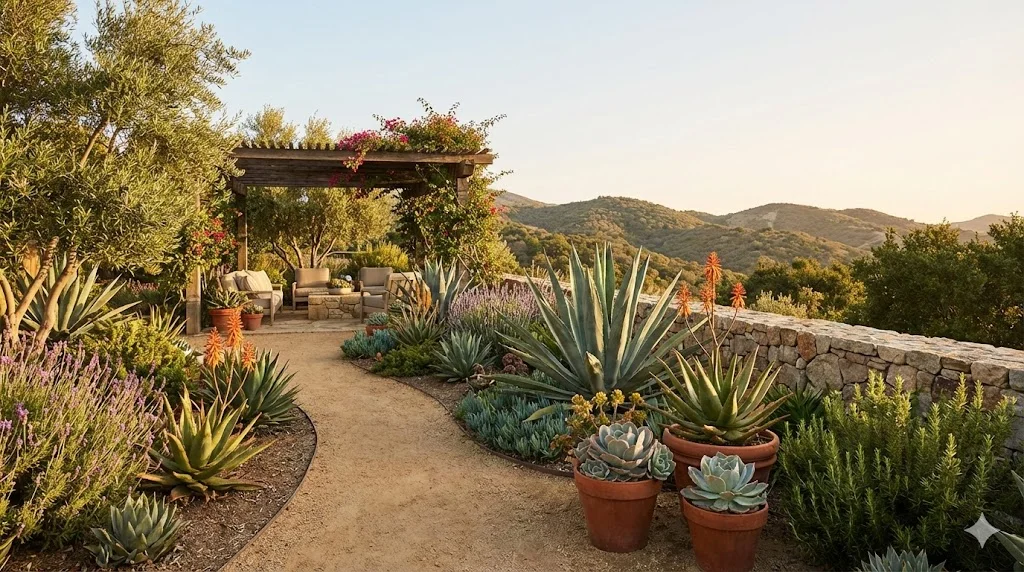
Garden Design for Southern California
Southern California is one of the world's most desirable garden climates — and one of the most misunderstood. The sunshine, mild temperatures, and year-round growing season suggest ease, but the reality is more nuanced. Water scarcity, fire risk, alkaline soils, and Santa Ana winds all shape what works and what fails in SoCal gardens. The most beautiful gardens in the region are those that have stopped trying to recreate the humid, green landscapes of the East Coast or the UK and have instead embraced the Mediterranean identity that defines Southern California at its best.
This guide is part of our Garden Design for Your Climate Zone series. It covers the specific strategies, plant palettes, and design approaches that create thriving, sustainable gardens in the SoCal climate — from the coast to the inland valleys to the mountain foothills.
Understanding the SoCal Climate
Southern California's climate is classified as Mediterranean, characterized by:
- Warm, dry summers: May through October brings almost no rain. Temperatures along the coast average 24–27 C (75–80 F), but inland valleys regularly hit 38–43 C (100–110 F).
- Mild, wet winters: November through April brings the region's annual rainfall — roughly 250–380 mm (10–15 inches) along the coast, less inland. Winter lows rarely drop below 4 C (40 F) at the coast, though inland valleys can see light frost.
- USDA Zones 9b–11a: Coastal SoCal is typically Zone 10a–10b; inland valleys Zone 9b–10a; mountain foothill areas Zone 9a–9b.
- Santa Ana winds: Hot, dry offshore winds that blow from the interior deserts, typically in fall. They desiccate plants, raise fire risk, and can reach 100 km/h (60 mph) or more.
- Microclimates: SoCal has extraordinary microclimatic variation. A garden two blocks from the beach may be 10 C cooler on a summer afternoon than one five miles inland. SoCal's climate fits squarely within the global patterns explored in our guide to garden design for Mediterranean climates.
Southern California has been called "the Mediterranean that California forgot." Its climate mirrors coastal Spain, southern Italy, and the western Cape of South Africa — regions with some of the world's most diverse and beautiful floras.
Fire-Safe Landscaping
Fire is the defining risk of gardening in many SoCal communities, especially in the Wildland-Urban Interface (WUI) zones of the foothills, canyons, and mountain areas. Fire-safe design does not mean a barren, sterile landscape — it means thoughtful plant selection, strategic spacing, and defensible zones.
Zone Framework for Fire Safety
- Zone 0 (0–1.5 m / 0–5 ft from structures) — Non-combustible materials only. Gravel, stone, concrete. No plants touching the house.
- Zone 1 (1.5–9 m / 5–30 ft) — Lean, clean, and green. Low-growing, high-moisture plants. Well-watered. No dead material, bark mulch, or wood fencing.
- Zone 2 (9–30 m / 30–100 ft) — Reduced fuel. Spacing between shrubs and trees. Low-growing ground covers. Removal of dead wood and leaf litter.
- Zone 3 (30–60 m / 100–200 ft) — Thinned native vegetation. Fire-resistant species preferred.
Fire-Resistant Plants for SoCal
Plants with high moisture content, low resin, and minimal dead material are the safest choices near structures:
- Succulents — Aloe, Agave, Echeveria, Sedum, Senecio. High water content makes them fire-resistant.
- Ice plant (Delosperma, Drosanthemum) — Succulent ground cover, effective firebreak
- Rockrose (Cistus) — Despite being Mediterranean, Cistus is relatively fire-resistant due to leaf moisture
- Ceanothus (California lilac) — Native, moderate fire resistance when well-maintained
- California fuchsia (Epilobium canum) — Low-growing, attracts hummingbirds, low fuel load
Avoid dense plantings of rosemary, juniper, and other highly resinous species close to structures. Inland SoCal gardens near the desert transition share many plant choices and water-harvesting strategies with the desert Southwest of Arizona and New Mexico.
Drought-Tolerant Garden Design
Water is SoCal's most precious resource. State mandates and rising water costs make drought-tolerant design not just environmentally responsible but financially smart. The good news is that drought-tolerant gardens can be among the most beautiful landscapes in the world.
The California Native Palette
California native plants are uniquely adapted to the SoCal climate and support local wildlife:
- California poppy (Eschscholzia californica) — The state flower, golden-orange, self-sowing
- Manzanita (Arctostaphylos) — Sculptural, red-barked, evergreen shrubs in dozens of species
- Toyon (Heteromeles arbutifolia) — Holly-like berries, evergreen, bird magnet
- Salvia clevelandii — Fragrant, hummingbird magnet, silvery foliage
- Buckwheat (Eriogonum) — Rounded mounds of white or pink flowers, essential pollinator plant
- Matilija poppy (Romneya coulteri) — Giant white crepe-paper flowers, dramatic presence
- Coast live oak (Quercus agrifolia) — The iconic SoCal shade tree, evergreen, deep-rooted
The Mediterranean Palette
Plants from similar Mediterranean climates worldwide thrive in SoCal:
- Lavender — Multiple species and varieties, fragrant, drought-proof
- Olive — Graceful, silvery, structural tree
- Bougainvillea — Vivid color on walls, arbors, and fences
- Rosemary — Edible, ornamental, ground cover or upright forms
- Leucadendron — South African shrubs with stunning foliage color
- Agapanthus — Blue or white globes on tall stems, evergreen in SoCal
- Ornamental grasses — Mexican feather grass (Nassella tenuissima), deer grass (Muhlenbergia rigens), purple fountain grass
When you experiment with drought-tolerant plant combinations in your design, you can see how textures, forms, and colors interact before committing to your final plan.
The Succulent Garden
Southern California is the world capital of succulent garden design. The frost-free climate allows outdoor cultivation of succulents that must be grown as houseplants elsewhere, and the sculptural, low-water aesthetic fits both the climate and the modern design sensibility of the region.
Designing with Succulents
- Mass planting — Large sweeps of a single species (Senecio mandraliscae, Echeveria 'Afterglow') create dramatic, contemporary displays
- Mixed tapestry — Combining succulents of different colors, textures, and heights creates living mosaics
- Container gardens — Succulents thrive in pots, bowls, and wall planters
- Rock gardens — Succulents nestled among boulders and gravel evoke a natural desert landscape
- Vertical gardens — Succulent-filled vertical panels and living walls are a SoCal specialty
Key Succulents for SoCal
- Agave attenuata — Soft, spineless rosettes, the SoCal signature plant
- Aloe arborescens — Large, structural, orange winter flowers
- Echeveria — Rosettes in pastel pinks, purples, greens, and greys
- Senecio mandraliscae — Blue chalk sticks, striking ground cover
- Aeonium — Rosettes on branching stems, dramatic forms
- Euphorbia — Diverse genus from ground covers to tree-sized specimens
Shade Strategies for SoCal
Shade is as important in SoCal garden design as sun exposure. Afternoon shade is essential for outdoor comfort from May through October.
- Shade trees — Coast live oak, jacaranda (stunning purple bloom), California pepper tree, ficus
- Pergolas and arbors — Covered outdoor rooms, especially effective when planted with grape vines, wisteria, or bougainvillea
- Shade sails — Modern, adjustable, available in UV-resistant fabrics
- East-facing patios — Receive pleasant morning sun and natural afternoon shade from the house
The best SoCal gardens are designed around shade. The shaded outdoor living area — whether a pergola-covered dining space, a hammock under an oak, or a succulent courtyard with a shade sail — is the heart of the garden.
Soil and Water Challenges
SoCal soils present specific challenges:
- Alkaline pH — Most SoCal soils are alkaline (pH 7.5–8.5), which limits iron availability and causes chlorosis in acid-loving plants. Amend with sulfur or use acid-loving species in containers with acidic potting mix.
- Clay soils — Common in inland valleys. Heavy, poorly drained when wet, cracking when dry. Improve with gypsum and organic matter.
- Sandy soils — Common near the coast. Drain fast, low nutrients. Improve with compost.
- Compacted decomposed granite — Common in foothill areas. May need to be broken up for root penetration.
Water-wise irrigation tips:
- Drip irrigation — The standard for SoCal gardens. Delivers water directly to roots.
- Smart controllers — Weather-based irrigation controllers adjust watering based on actual conditions.
- Deep, infrequent watering — Encourages deep root systems that are more drought-resilient.
- Irrigate at dawn — Minimizes evaporation and reduces fungal disease risk.
Designing for Year-Round Interest
SoCal's mild climate allows year-round garden enjoyment, but without seasonal drama, gardens can feel static. Design for change by incorporating:
- Winter bloomers — Aloe, winter cassia, coral tree (Erythrina), Mexican sage
- Spring wildflower display — California poppies, lupines, and native annuals sown in fall
- Summer structure — Succulents, grasses, and Mediterranean shrubs at their architectural best
- Fall color accents — Chinese pistache, crape myrtle, and ornamental grasses provide warm tones
Getting Started: Your SoCal Garden Plan
- Know your microclimate — Coastal, inland valley, or foothill? Each demands a different approach. Check your Sunset Climate Zone for the best local guidance.
- Assess fire risk — If you are in a WUI zone, prioritize fire-safe design from the start.
- Remove or reduce lawn — Take advantage of turf replacement rebates offered by many SoCal water agencies.
- Start with native and Mediterranean plants — They are adapted to your exact conditions and require the least maintenance.
- Install drip irrigation — Even drought-tolerant plants need water during establishment. Drip irrigation makes every drop count.
- Mulch with gravel or decomposed granite — Inorganic mulch is preferred in fire zones and reduces evaporation without breaking down.
- Design outdoor living spaces — SoCal's climate is made for outdoor living. Prioritize shade, comfortable seating, and connection between indoor and outdoor spaces.
- Plant in fall — October through December is the ideal planting season in SoCal. Winter rains establish roots before the dry summer.
Southern California gardens, when designed with an honest understanding of the climate, are among the most beautiful and livable landscapes in the world. The palette of native and Mediterranean plants offers year-round color, fragrance, and texture with a fraction of the water and maintenance that conventional landscapes demand. This is a place where the garden and the climate can truly be in harmony.
Garden Design Team
Expert garden designers sharing tips, inspiration, and practical advice for creating beautiful outdoor spaces.
Explore professional garden design
Gardenly3D is a paid professional garden-design application. See plans for included capabilities and availability.
Join the waitlistRelated articles
Garden Design for Australian Conditions
Design a resilient Australian garden with native plants, bushfire-safe landscaping, water-wise strategies, and solutions for subtropical to arid climates.
Garden Design for Canada
Design a resilient Canadian garden with extreme cold strategies, native prairie and boreal plants, short season planting, and wildlife-friendly garden design.
Garden Design for Coastal Mediterranean (Spain, Italy, Greece)
Design a stunning coastal Mediterranean garden with bougainvillea, citrus, courtyards, dry stone walls, and irrigation strategies for Spain, Italy, and Greece.