
Pollinator-Friendly Garden Design: Beyond the Bee Hotel
Design a truly pollinator-friendly garden with bloom calendars, native plants, nesting habitat, water sources, and pesticide-free strategies beyond bee hotels.
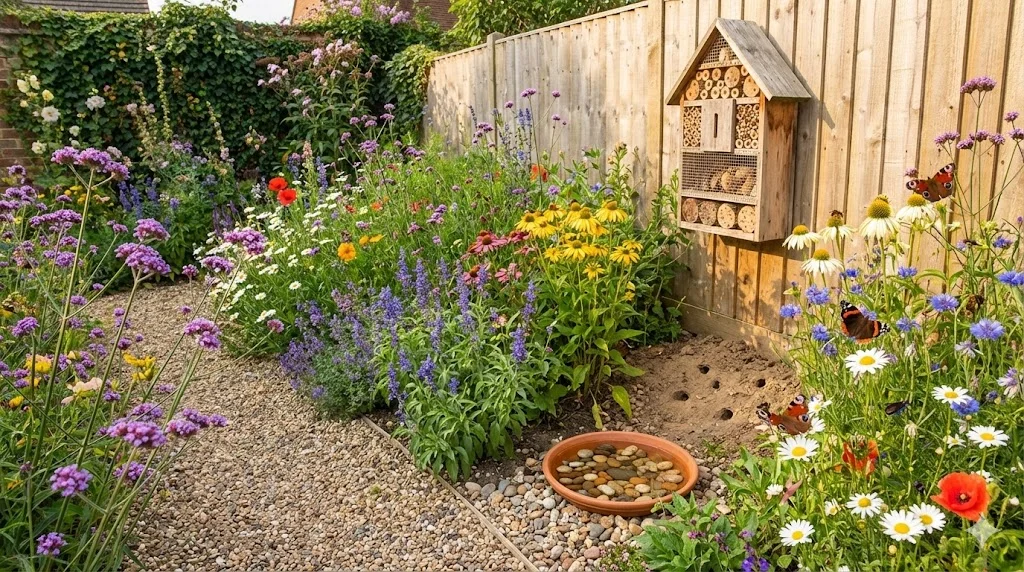
Pollinator-Friendly Garden Design: Beyond the Bee Hotel
Bee hotels are everywhere. They have become the symbol of pollinator-friendly gardening — neat, photogenic, and available at every garden centre. But here is the uncomfortable truth: a bee hotel without a pollinator-friendly garden is like hanging a bird box in a concrete car park. The gesture is well-intentioned, but without food, water, and the right habitat, it makes little real difference.
True pollinator-friendly garden design goes far beyond a single installation. It means designing your entire garden — plant selection, bloom timing, maintenance practices, and habitat provision — to support the full lifecycle of bees, butterflies, hoverflies, moths, and the thousands of other pollinating insects that sustain our ecosystems and food supply. The good news is that a garden designed for pollinators is also a more beautiful, more interesting, and more dynamic garden for people.
The Pollinator Crisis: Why It Matters
Pollinators are in steep decline worldwide. Habitat loss, pesticide use, disease, and climate change have reduced populations of wild bees, butterflies, and other pollinating insects by alarming margins. This matters because pollinators are responsible for the reproduction of approximately 80 percent of flowering plants and the production of roughly one-third of all human food.
Private gardens are one of the most important refuges for pollinators, particularly in urban and suburban areas where farmland has become inhospitable. Your garden can be part of the solution — but only if it is designed with pollinator needs genuinely in mind.
What Pollinators Actually Need
1. Continuous Bloom from February to November
This is the single most important thing you can provide. Pollinators need nectar and pollen throughout their active season — not just during the summer peak. Many gardeners plant plenty of summer flowers but leave pollinators starving in early spring and late autumn.
A pollinator bloom calendar:
- February–March: Crocuses, snowdrops, winter aconites, hellebores, Pulmonaria, willow catkins
- April–May: Forget-me-nots, apple blossom, bluebells, wallflowers, Aubrieta, Bugle (Ajuga)
- June–July: Lavender, salvias, foxgloves, geraniums, catmint (Nepeta), alliums, Verbascum
- August–September: Echinaceas, verbena bonariensis, sedums, heleniums, sunflowers, single dahlias
- October–November: Ivy (critical late food source), Fatsia japonica, autumn-flowering Sedum, late-flowering asters, Cyclamen hederifolium
"A pollinator-friendly garden is not defined by what blooms in July — it is defined by what blooms in February and November."
2. The Right Flower Shapes
Not all flowers are equally accessible to pollinators. Highly bred double flowers — those with extra layers of petals — often have no nectar or pollen at all. The breeding that created their showy appearance eliminated their ecological function.
Best flower types for pollinators:
- Single, open flowers: Daisies, geraniums, cosmos — easy access to nectar and pollen.
- Tubular flowers: Foxgloves, penstemons, salvias — favoured by long-tongued bees and butterflies.
- Umbellifers: Flat-topped clusters (fennel, Ammi, Angelica) — perfect landing platforms for smaller insects.
- Composite flowers: Echinaceas, sunflowers, asters — each "flower" is actually hundreds of tiny florets, each with its own nectar reward.
Avoid: Double roses, double dahlias, double marigolds, and any flower bred for extra petals at the expense of reproductive parts.
3. Native Plants
While many garden plants from around the world provide nectar, native plants are uniquely important because they support specialist pollinators that have co-evolved with them and cannot use exotic alternatives.
In a UK or Northern European garden, important native pollinator plants include:
- Wildflowers: Red clover, bird's-foot trefoil, knapweed, field scabious, viper's bugloss, teasel
- Trees: Willow (vital early pollen), hawthorn, blackthorn, crabapple, lime, rowan
- Hedgerow plants: Ivy (critical late nectar), bramble, dog rose, elder, hazel
- Herbs: Wild marjoram, thyme, mint
A good target is for native plants to make up at least 30 percent of your planting. The rest can be garden-worthy non-natives chosen for their pollinator value.
4. Nesting Habitat
Pollinators need places to nest, and different species need very different habitats:
Ground-nesting bees (the majority of wild bee species):
- Leave patches of bare, south-facing soil undisturbed. These are prime nesting sites.
- Avoid covering every surface with mulch — some bare soil is essential.
- South-facing banks and slopes are ideal.
Cavity-nesting bees:
- Dead wood with beetle holes provides natural nesting cavities.
- Bee hotels (when well-designed) can supplement natural habitat. Use tubes of varying diameters (2 to 10 mm), placed in a warm, sheltered, south-facing location. Clean annually to prevent parasites.
- Hollow stems of perennials left standing through winter provide natural nesting tubes.
Bumblebees:
- Old mouse holes, compost heaps, and tussocky grass provide nesting sites.
- Bumblebee nest boxes have a low success rate but are worth trying in suitable locations.
Butterflies:
- Caterpillar food plants are essential. Many butterflies lay eggs only on specific plants — nettles (for Peacock, Red Admiral, Small Tortoiseshell), lady's smock (for Orange Tip), buckthorn (for Brimstone).
- Dense vegetation provides shelter for overwintering butterflies.
- Ivy and hollow trees provide hibernation sites.
5. Water
Pollinators need water, especially in hot weather. Provide:
- A shallow dish with pebbles or stones for insects to land on while drinking.
- A bird bath (also used by larger insects).
- Muddy puddles — some butterflies and bees extract minerals from damp soil.
- A wildlife pond with shallow margins.
6. A Pesticide-Free Garden
Pesticides — including many organic ones — are harmful to pollinators. A genuinely pollinator-friendly garden is pesticide-free.
- Neonicotinoids: Systemic insecticides that persist in plant tissue, nectar, and pollen. Banned for outdoor use in many countries but still present in some products. Avoid all neonicotinoid-treated plants and products.
- Glyphosate: Eliminates wildflowers that support pollinators. Avoid.
- Organic pesticides: Pyrethrum, rotenone, and spinosad all kill pollinators alongside target pests. Use only as a last resort and never on open flowers.
The alternative is to build a diverse garden ecosystem that naturally controls pests through predator-prey balance. Ladybirds, hoverflies, ground beetles, and parasitic wasps all thrive in a pesticide-free, biodiverse garden.
Designing Pollinator Borders
The Pollinator Strip
Even a narrow border (1 metre wide) can support pollinators if planted with a succession of single, nectar-rich flowers. Position along a sunny boundary:
Spring: Crocus tommasinianus + Pulmonaria + Bugle Early summer: Geranium 'Rozanne' + Salvia nemorosa + Nepeta High summer: Lavender + Echinacea + Verbena bonariensis Autumn: Sedum 'Herbstfreude' + Aster 'Little Carlow' + single dahlia
The Pollinator Meadow
A wildflower meadow is the ultimate pollinator habitat. Even a small patch (3 x 3 metres) of native wildflowers and grasses supports more pollinator species than an entire conventional border. See our guide on no-mow garden design and lawn alternatives.
The Herb Garden as Pollinator Magnet
Flowering herbs are among the most effective pollinator plants:
- Lavender: One of the top nectar plants for honeybees and bumblebees.
- Rosemary: Early spring flowers when little else is available.
- Thyme: Low-growing, massively attractive to bees when in flower.
- Oregano/Marjoram: Pink flowers that bees go wild for in midsummer.
- Borage: Replenishes nectar every few minutes — the ultimate bee restaurant.
- Chives: Purple flower heads buzzing with pollinators from May.
- Mint: Late-summer flowers valuable for bees.
A herb garden near the kitchen serves double duty — culinary value for you, critical food for pollinators.
What About Bee Hotels?
Bee hotels are valuable — but only as part of a broader pollinator strategy. They are most effective when:
- Properly designed: Use smooth-bore tubes (not jagged-cut bamboo) in diameters from 2 to 10 mm. Mason bees prefer 8 to 10 mm; smaller bees prefer 2 to 4 mm.
- Properly positioned: South-facing, at least 1 metre off the ground, sheltered from rain.
- Properly maintained: Replace tubes annually to prevent parasite build-up. Unused, damp tubes develop mould and parasites that can harm the bees they are meant to help.
- Supplemented with natural habitat: Bare soil, dead wood, and hollow stems are equally important nesting sites.
"A bee hotel is a welcome sign. But the garden behind it must deliver on the promise."
Planning Your Pollinator Garden
When you design your garden layout for pollinators, map out bloom succession and habitat features to ensure continuous support:
- Mark sunny spots for nectar-rich planting — pollinators are most active in warm, sheltered locations.
- Identify nesting zones — south-facing bare soil, dead wood locations, and sheltered spots for bee hotels.
- Plan water access — a shallow dish or pond positioned in a sunny spot.
- Map your bloom calendar month by month and fill any gaps.
Getting Started
Three actions that make an immediate difference for pollinators:
- Plant three pollinator plants that bloom outside summer. Crocus tommasinianus (February), Pulmonaria (March), and Sedum 'Herbstfreude' (September) fill the three most critical gaps in a typical garden's pollinator provision.
- Stop using all pesticides. This single decision does more for pollinators than any amount of planting. Within two years, you will notice a dramatic increase in beneficial insect diversity.
- Leave some stems standing. In autumn, resist the urge to cut everything back. Hollow stems provide overwintering habitat for solitary bees and other beneficial insects. Cut back in late spring instead.
A truly pollinator-friendly garden is more than a gesture — it is a functioning ecosystem. Design for pollinators, and you design a garden that is alive with movement, colour, and purpose throughout the year. For the wider sustainable gardening framework, visit our sustainable garden design guide.
Garden Design Team
Expert garden designers sharing tips, inspiration, and practical advice for creating beautiful outdoor spaces.
Explore professional garden design
Gardenly3D is a paid professional garden-design application. See plans for included capabilities and availability.
Join the waitlistRelated articles
Carbon-Positive Garden Design: Sequestering Carbon at Home
Design a carbon-positive garden that sequesters carbon through tree planting, biochar, peat-free growing, reduced hardscape, and soil health strategies.
Composting and Soil Health for Garden Designers
Master composting and soil health for better garden design with guidance on the soil food web, composting methods, mulch types, no-dig gardening, and more.
No-Mow Garden Design: Lawn Alternatives That Thrive
Explore no-mow garden design with lawn alternatives that thrive, including clover lawns, creeping thyme, moss gardens, meadow patches, and ground covers.