
Water-Wise Garden Design: Reducing Your Water Footprint
Reduce your garden water footprint with rain barrels, drip irrigation, mulching, drought-tolerant species, grey water systems, and smart design strategies.
Water-Wise Garden Design: Reducing Your Water Footprint
Water is the most precious resource in any garden, and it is becoming more precious every year. Changing rainfall patterns, hotter summers, and increasing demand on water supplies mean that gardeners everywhere — not just in traditionally dry climates — need to think seriously about how they use water. A typical garden in a temperate climate can consume thousands of litres of mains water each summer. Most of this is avoidable.
Water-wise garden design is about reducing your garden's water footprint without reducing its beauty or productivity. Through smart design, efficient irrigation, appropriate plant selection, and water harvesting, you can create a garden that thrives through dry spells while using a fraction of the water that conventional gardens demand.
Understanding Your Garden's Water Use
Before you can reduce water use, you need to understand where it goes. In a typical garden:
- Lawns account for 30 to 50 percent of total water use. Closely mown lawns in full sun are the thirstiest element in most gardens.
- Containers and hanging baskets use disproportionate amounts of water relative to their planted area, because they dry out quickly.
- Annual bedding has shallow roots and high water needs compared to established perennials.
- Newly planted trees and shrubs need supplemental water for their first one to two growing seasons.
- Established perennial borders typically need far less water than most gardeners give them, especially when mulched.
"The first step to a water-wise garden is knowing where your water goes. The second step is designing so it does not need to go there."
Rainwater Harvesting
The most sustainable water for your garden falls free from the sky. Capturing and storing rainwater is one of the simplest and most effective steps toward water independence.
Rain Barrels and Butts
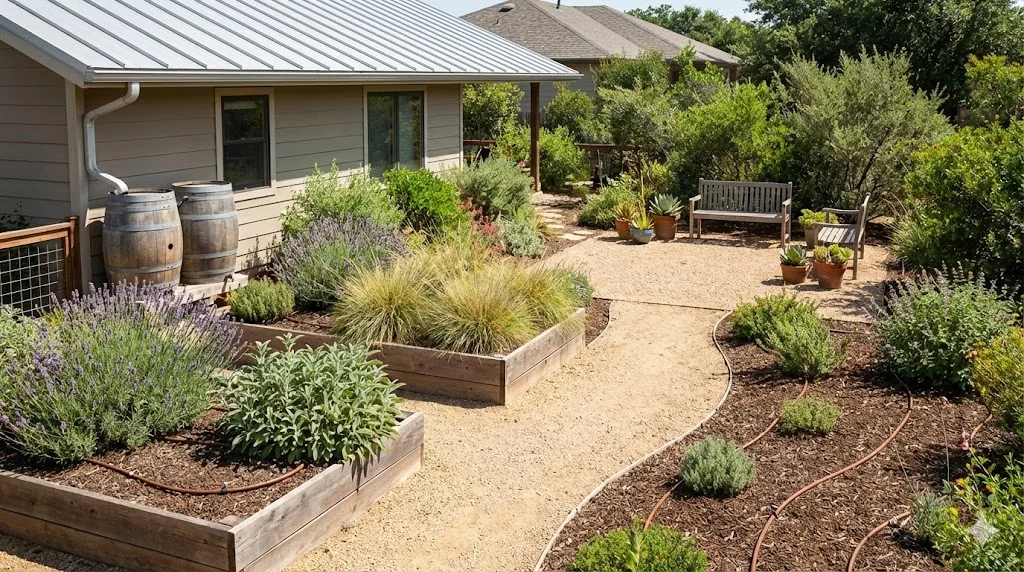
A standard rain barrel (200 to 300 litres) connected to a downpipe captures a surprising amount of water. A typical roof in a temperate climate can yield 50,000 to 80,000 litres of rainfall per year — far more than most gardens need.
Installation tips:
- Connect barrels to as many downpipes as possible.
- Link multiple barrels together with overflow connectors to maximise storage.
- Elevate barrels on stands for gravity-fed watering with a hose.
- Install a first-flush diverter to keep the initial (dirtiest) roof runoff out of your barrel.
- Use a lid or screen to prevent mosquito breeding and debris entry.
Larger Rainwater Systems
For more ambitious water independence:
- Underground tanks: 1,000 to 10,000 litre tanks buried in the garden provide substantial storage without visible impact.
- IBC tanks: Intermediate Bulk Containers (1,000 litres) are affordable and can be disguised with screening or planting.
- Pump systems: A submersible pump in a tank allows you to run drip irrigation directly from stored rainwater.
Rain Gardens
A rain garden is a planted depression that captures stormwater runoff from roofs, driveways, and paved areas. Instead of sending this water to the storm drain, it infiltrates slowly through soil, filtering pollutants and recharging groundwater.
Rain garden plants: Choose species that tolerate both wet and dry conditions — iris sibirica, deschampsia, astilbe, geum, caltha, and native sedges.
Efficient Irrigation
When you do need to water, efficiency is everything. The goal is to deliver water exactly where it is needed with minimal waste.
Drip Irrigation
Drip irrigation is the gold standard for efficient garden watering. Thin tubes with emitters deliver water directly to the root zone of each plant, reducing waste by 50 to 70 percent compared to sprinklers.
Benefits:
- Minimal evaporation (water goes to roots, not leaves or air)
- Reduced disease (dry foliage is less prone to fungal infection)
- Precise control (each area gets exactly what it needs)
- Automation (connect to a timer for hands-free watering)
Installation: Modern drip systems are surprisingly easy to install. Main supply hoses run along borders, with smaller drip tubes branching off to individual plants or zones.
Watering Best Practices
- Water deeply and infrequently. One thorough soak twice a week is far better than a light daily sprinkle. Deep watering encourages roots to grow downward toward moisture, creating more drought-resistant plants.
- Water in the early morning. Evaporation is lowest, water pressure is typically highest, and plants have time to absorb moisture before the heat of the day.
- Water the soil, not the plant. Direct water at the base of plants, not over foliage.
- Use a watering can strategically. For targeted watering of specific plants, a watering can is more efficient than any hose.
Smart Controllers
Modern irrigation controllers use weather data and soil moisture sensors to water only when needed. They adjust automatically for rain, temperature, and humidity — preventing the common problem of sprinklers running during a rainstorm.
Mulching: The Water-Saving Superpower
Mulching is the single most effective action for reducing water loss in garden borders. A 5 to 10 cm layer of mulch:
- Reduces evaporation by up to 70 percent
- Suppresses water-competing weeds
- Keeps soil cool, reducing plant stress
- Improves soil structure as organic mulches decompose
Organic Mulches
- Bark chips: Long-lasting, attractive, widely available.
- Wood chips: Free from tree surgeons, excellent for paths and shrub borders.
- Garden compost: Feeds the soil as it mulches.
- Straw: Excellent for vegetable gardens. Decomposes faster than bark.
- Leaf mould: The finest mulch of all — crumbly, moisture-retentive, and free if you compost your own leaves.
Inorganic Mulches
- Gravel and pebbles: Perfect for Mediterranean and xeric planting schemes. Long-lasting and weed-suppressing.
- Slate chips: Dark, attractive, and effective.
- Decomposed granite: A natural look for paths and planting areas.
Designing with Drought-Tolerant Plants
The most effective long-term strategy for reducing water use is choosing plants that do not need much water in the first place.
What Makes a Plant Drought-Tolerant?
Plants adapted to dry conditions have evolved specific features:
- Silver or grey foliage: Reflects light and reduces water loss (lavender, artemisia, stachys).
- Small or narrow leaves: Reduced surface area means less transpiration (rosemary, thyme, grasses).
- Waxy or hairy leaf coatings: Reduce water loss through the leaf surface (sedums, echeverias).
- Deep tap roots: Access water deep in the soil profile (echinaceas, verbascums).
- Dormancy strategies: Some plants go dormant during drought, reviving when moisture returns.
Top Drought-Tolerant Plants for Beautiful Borders
- Lavender — fragrant, pollinator-friendly, architectural
- Salvia — long-flowering, heat-loving, available in a wide colour range
- Perovskia — airy, silvery, and supremely drought-hardy
- Eryngium — architectural steel-blue flowers
- Achillea — flat-topped flowers in warm tones, spreading and reliable
- Stipa tenuissima — soft, flowing grass that thrives in dry conditions
- Nepeta — billowing mounds of blue-grey, flowering for months
- Cistus — Mediterranean rock rose with papery flowers
- Phlomis — architectural whorled flowers, very drought-tolerant
Grey Water: Reusing Household Water
Grey water — water from baths, showers, and washing machines — can be reused in the garden, reducing mains water consumption significantly.
Guidelines for Grey Water Use
- Use water from baths, showers, and washing machines (not dishwashers or toilets).
- Apply directly to soil, not over foliage.
- Use eco-friendly, biodegradable soaps and detergents.
- Do not store grey water for more than 24 hours (bacteria multiply).
- Rotate grey water application across different areas.
- Avoid using grey water on edible crops.
- Do not use water that contains bleach, disinfectant, or harsh chemicals.
Simple Grey Water Systems
- Bathwater siphon: A simple siphon tube allows you to drain bathwater directly into the garden.
- Washing machine diverter: A valve on the waste pipe redirects rinse water to the garden rather than the drain.
- Grey water recycling systems: More sophisticated systems filter and store grey water for later use via drip irrigation.
Reducing Lawn Water Use
Lawns consume more water than any other garden element. Reducing lawn area or changing lawn management dramatically reduces total water use.
Alternatives to Thirsty Lawns
- Clover lawn: White clover stays green in drought, fixes nitrogen, and supports pollinators.
- Creeping thyme: Fragrant, flowering, and remarkably drought-tolerant.
- Meadow conversion: Converting some lawn to wildflower meadow eliminates watering entirely.
- Gravel garden: Replacing decorative (non-functional) lawn with gravel and drought-tolerant planting.
For more lawn alternatives, see our guide on no-mow garden design.
Managing Existing Lawns
If you want to keep some lawn:
- Mow higher. Longer grass shades the soil, reducing evaporation and keeping roots cooler.
- Leave clippings. Mulch-mowing returns moisture and nutrients to the lawn.
- Accept some browning. Established lawns recover from drought. They go dormant and brown but green up again with autumn rain.
- Water only when truly necessary. And when you do, water deeply and early in the morning.
"A brown lawn in summer is not a dead lawn — it is a dormant lawn. It will recover. Your mains water supply may not."
Designing Your Water-Wise Garden
When you plan your garden layout, incorporate water conservation from the design stage:
- Zone by water need: Place thirsty plants nearest your water source and drought-tolerant plants furthest away.
- Position rain barrels: Design downpipe connections and barrel placement into the garden plan.
- Plan rain gardens: Identify where runoff naturally flows and design planted depressions to capture it.
- Minimise exposed soil: Ensure every border is mulched and every gap is planted.
- Design shade: Trees and structures that shade borders reduce evaporation from the soil beneath.
Getting Started
Three changes that will immediately reduce your garden's water footprint:
- Install a rain barrel. Connect it to your nearest downpipe today. Even one barrel provides hundreds of litres of free water through summer.
- Mulch every border. Apply 7 to 10 cm of bark, compost, or gravel. The water savings start immediately and compound as soil improves.
- Replace one thirsty area. Convert a patch of decorative lawn to gravel planting, or swap annual bedding for established drought-tolerant perennials.
Water-wise gardening is not about having a dry, austere garden. It is about designing intelligently, choosing the right plants, and using water where it matters most. The result is a garden that looks lush and beautiful while using a fraction of the water that conventional gardens waste. For the full sustainable design context, visit our sustainable garden design guide.
Garden Design Team
Expert garden designers sharing tips, inspiration, and practical advice for creating beautiful outdoor spaces.
Explore professional garden design
Gardenly3D is a paid professional garden-design application. See plans for included capabilities and availability.
Join the waitlistRelated articles
Carbon-Positive Garden Design: Sequestering Carbon at Home
Design a carbon-positive garden that sequesters carbon through tree planting, biochar, peat-free growing, reduced hardscape, and soil health strategies.
Composting and Soil Health for Garden Designers
Master composting and soil health for better garden design with guidance on the soil food web, composting methods, mulch types, no-dig gardening, and more.
No-Mow Garden Design: Lawn Alternatives That Thrive
Explore no-mow garden design with lawn alternatives that thrive, including clover lawns, creeping thyme, moss gardens, meadow patches, and ground covers.